Best Renter-Friendly Kitchen Storage Ideas for Apartments
US Top List may earn from qualifying purchases through affiliate links. As an Amazon Associate, we earn from qualifying purchases.
Renter-Friendly Kitchen Storage
Create More Kitchen Space Without Drilling, Remodeling, or Risking Your Deposit
A small apartment kitchen can feel frustrating fast: too few cabinets, crowded counters, awkward drawers, no pantry, and a lease that makes permanent changes risky. The best renter-friendly kitchen storage ideas do not try to turn your rental into a remodel project. They help you use the space you already have more intelligently, with organizers you can remove, move, or take with you later.
If you are renting, kitchen storage is not just about making things look neat. It is about protecting your daily routine. When your coffee, pans, snacks, cleaning supplies, food containers, and dish towels all compete for the same few cabinets, cooking starts to feel harder than it should. You may stop making meals at home, buy duplicates because you cannot find what you already own, or leave items on the counter simply because there is nowhere else to put them.
This guide is written for renters who want a more usable kitchen without drilling holes, changing cabinets, installing permanent shelves, or buying oversized furniture that may not fit the next apartment. It is especially helpful if your kitchen has limited cabinets, a narrow counter, a tiny pantry, a shared rental layout, or an under-sink area that has turned into a pile of bags, bottles, and mystery items.
For a broader starting point, you may also want to read our Small Kitchen Storage Ideas for Apartments, Best Kitchen Organizers for Small Apartments, and No Drill Storage Ideas for Renters. This article focuses specifically on kitchen storage choices that make sense for renters.
Quick Picks: Renter-Friendly Kitchen Storage Worth Considering
Start with one problem area instead of buying every organizer at once. These Amazon searches are useful starting points for common apartment kitchen storage problems.
- Over-the-cabinet door organizers for wraps, cutting boards, dish towels, or cleaning supplies
- Under-shelf baskets for mugs, snacks, foil boxes, napkins, or lightweight pantry items
- Expandable shelf risers for plates, bowls, cans, and pantry cabinets
- Slim rolling storage carts for narrow gaps beside the fridge or counter
- Magnetic spice racks for the side of a refrigerator or metal surface
- Kitchen drawer organizers for utensils, tools, tea bags, and small cooking items
- Adjustable under-sink organizers for cleaning supplies and extra bags
- Stackable pantry bins for snacks, breakfast items, packets, and shelf overflow
- Damage-free adhesive kitchen hooks for light tools, towels, measuring cups, and potholders
Best First Step
Fix the Cabinet You Use Daily
Most renters get the biggest improvement from organizing plates, pans, food containers, or pantry items before buying decorative storage.
Best No-Drill Areas
Doors, Shelves, Fridge Sides
Cabinet doors, under-shelf space, and the side of a refrigerator can create extra storage without changing the apartment.
Avoid First
Permanent or Oversized Fixes
Skip anything that requires drilling, heavy wall mounting, or a large footprint before you understand your kitchen layout.
What Makes Kitchen Storage Renter-Friendly?
Renter-friendly kitchen storage should solve a real problem without creating a new problem at move-out. In a rental, the best organizers are usually removable, lightweight, adjustable, and flexible enough to work in more than one apartment. A storage item is not truly renter-friendly just because it is small. It also needs to respect your lease, your cabinet surfaces, your limited floor space, and the possibility that you may move again.
Good renter-friendly kitchen storage usually falls into a few categories: organizers that sit inside cabinets, items that hang over cabinet doors, under-shelf baskets that slide onto existing shelves, magnetic pieces that attach to metal appliances, freestanding carts, drawer dividers, tension-based solutions, and adhesive products used carefully on appropriate surfaces. These are easier to remove than screwed-in shelves, wall-mounted racks, or permanent fixtures.
The main rule is simple: before buying, ask where the organizer will go, what it will hold, how heavy those items are, and whether you can remove it without damage. A spice rack on the side of the fridge is usually low-risk. A heavy adhesive shelf loaded with glass jars on painted drywall is much riskier. A slim rolling cart can move with you. A custom shelf built into a wall may create lease problems.
Start With the Problem, Not the Product
One of the easiest ways to waste money on small kitchen storage is to buy organizers before identifying the real source of the mess. A beautiful bin will not fix a drawer that is too full. A spice rack will not help if your main problem is food containers falling out of a cabinet. A rolling cart may look useful, but if your kitchen walkway is already tight, it can make cooking more annoying.
Before shopping, stand in your kitchen and look at your daily routine. Where do you lose time? Where do items pile up? Which cabinet do you avoid opening because everything falls forward? Which counter area becomes a dumping zone? Which items do you use every day but never have a good place for? Those answers matter more than any product list.
For many renters, the first problem area is one of these: food storage containers, pots and pans, pantry overflow, spices, cleaning products under the sink, too many utensils in one drawer, dish towels with nowhere to hang, or a counter crowded with appliances. Choose one area first. When you solve one daily frustration, the whole kitchen often feels easier to use.
1. Use Over-the-Cabinet Door Organizers for Hidden Storage
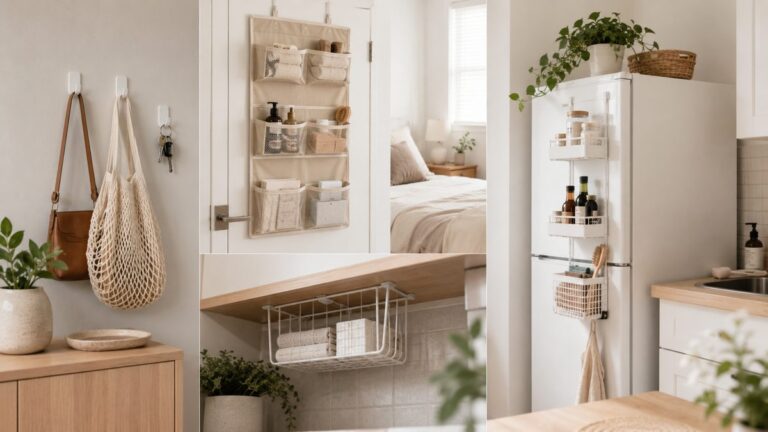
Cabinet doors are often wasted space in apartment kitchens. Over-the-cabinet door organizers can add storage without screws, nails, or permanent hardware. They simply hang over the top of a cabinet door and can usually be removed in seconds. This makes them especially useful for renters who cannot drill into cabinets or walls.
These organizers work well for lightweight or medium-weight items such as cutting boards, food wrap boxes, parchment paper, foil, sandwich bags, dish towels, pot lids, and some cleaning supplies. Under the sink, an over-door basket can hold sponges, extra trash bags, dishwasher pods, or small spray bottles. Near the prep area, one can keep cutting boards and wrap boxes upright instead of buried in a drawer.
The key is clearance. Before buying, measure the thickness of your cabinet door and check whether the door can still close with the organizer installed. Some apartment cabinets have tight frames or shelves that sit very close to the door. If the organizer bumps into plumbing, shelves, or cabinet contents, it will become frustrating quickly.
Also think about noise and scratching. Some over-door organizers come with foam pads or soft backing. If yours does not, you may want to add small felt pads where metal touches the cabinet. This small detail can help protect cabinet finishes and make the organizer feel less clunky when you open and close the door.
2. Add Under-Shelf Baskets to Use Empty Vertical Space
Most kitchen cabinets have more vertical space than they appear to have. The problem is that renters often stack items directly on top of one another, which makes everything harder to reach. Under-shelf baskets are simple organizers that slide onto an existing shelf and create a small hanging layer below it. No drilling is needed.
Use under-shelf baskets for lighter items: tea boxes, coffee filters, napkins, small snacks, tortillas, mugs, food wraps, dish towels, or reusable bags. They are especially helpful in tall cabinets where there is unused space above shorter items. Instead of stacking everything into one unstable pile, you create a second level.
However, under-shelf baskets are not ideal for heavy cookware or fragile glass items. They depend on the shelf they slide onto, and overloaded baskets can sag or become difficult to pull items from. Think of them as a way to organize light overflow, not as a replacement for sturdy cabinet shelving.
If your cabinets are shallow, measure carefully. A basket that sticks out too far can prevent cabinet doors from closing. If your shelves are thick, check the product dimensions before buying. The best under-shelf basket is one you barely notice because it fits naturally into the cabinet instead of fighting the cabinet.
3. Use Shelf Risers for Plates, Bowls, Cans, and Pantry Items
Shelf risers are one of the safest renter-friendly kitchen upgrades because they simply sit inside your cabinets. They do not attach to the wall, cabinet, or shelf. They are useful when you have tall shelves but only one flat surface, which forces you to stack plates, bowls, pantry items, or mugs too high.
In a dish cabinet, a shelf riser can separate plates from bowls or mugs. In a pantry cabinet, it can make cans, jars, spices, and small boxes easier to see. On a counter, a riser can lift frequently used items like coffee supplies without taking over the entire workspace. For small apartment kitchens, visibility matters. If you can see what you own, you are less likely to buy duplicates or let food expire in the back of a cabinet.
Expandable shelf risers can be especially useful because apartment cabinets vary widely. If you move later, an adjustable riser has a better chance of fitting the next kitchen. Look for stable legs, a surface that matches what you plan to store, and a width that fits without blocking cabinet hinges.
The mistake to avoid is using risers to keep too much. If a shelf riser lets you stack five more mugs you never use, it has not really improved the kitchen. It has just helped you keep clutter more neatly. Use risers to make daily items easier to reach, not to delay decluttering.
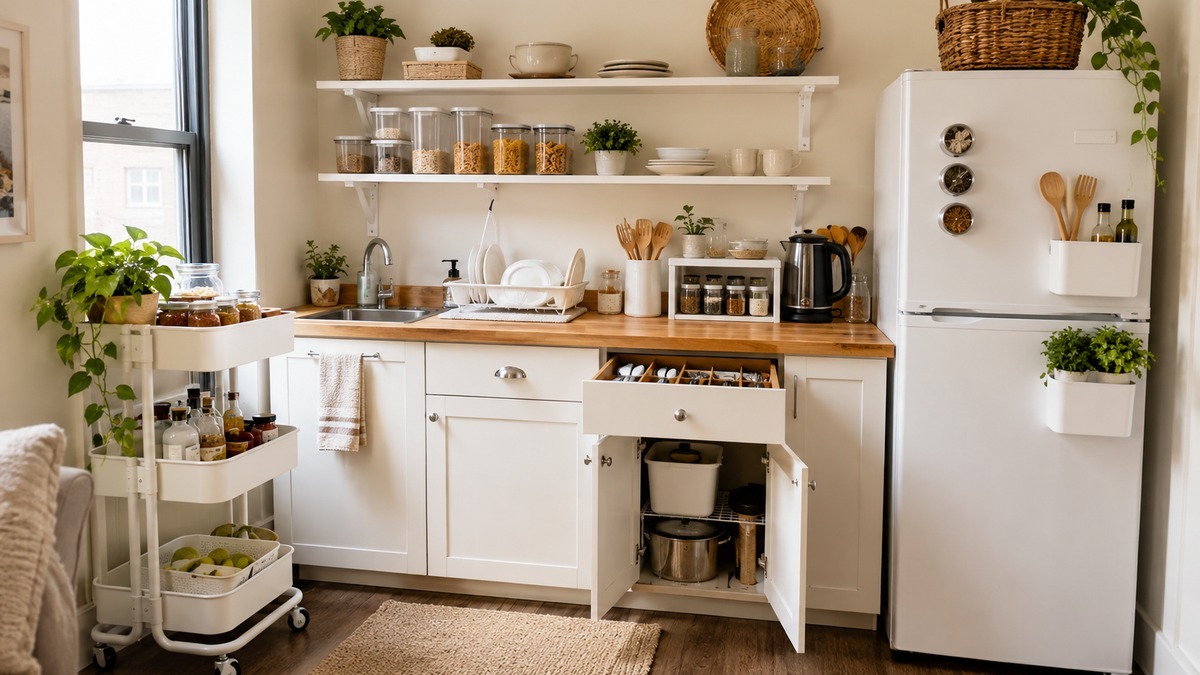
4. Try a Slim Rolling Cart Only If You Have a Real Gap
A slim rolling cart can be great in an apartment kitchen, but only when it fits the space naturally. Many renters have a narrow gap beside the refrigerator, next to a counter, between an appliance and a wall, or near a dining area. A slim cart can turn that awkward gap into storage for snacks, oils, baking supplies, coffee items, cleaning supplies, or extra pantry goods.
The advantage of a rolling cart is that it is completely removable. You can pull it out when you need something, clean around it, and take it with you when you move. It does not depend on wall space or cabinet modifications. For renters with no pantry, a cart can act as a small movable pantry.
But a cart can also become another clutter magnet. If it blocks the kitchen walkway, catches on rugs, bumps into the fridge door, or becomes a pile of random items, it may make your kitchen feel smaller. Measure the width, depth, and height of the gap before buying. Also consider whether wheels will roll well on your floor.
A slim cart works best when it has a clear job. For example: one cart for coffee and tea, one for pantry overflow, one for baking supplies, or one for lunch-packing items. If you use it as a place for everything, it will quickly become hard to use.
5. Use Magnetic Storage on the Fridge Side
If your apartment refrigerator has an exposed magnetic side, it can become valuable storage space. Magnetic spice racks, magnetic paper towel holders, magnetic hooks, and magnetic baskets can hold light items without drilling or adhesive. This is one of the most renter-friendly options because it usually leaves no wall or cabinet damage.
Magnetic storage works well for spices, measuring spoons, oven mitts, small towels, foil boxes, wraps, grocery lists, and lightweight cooking tools. It is especially helpful when cabinet space is limited but the side of the fridge is empty.
Before buying, check whether your fridge side is actually magnetic. Some stainless-looking appliances are not strongly magnetic on every surface. Also think about heat and traffic. Avoid placing oils, spices, or paper products too close to a stove. Do not put bulky racks where they will catch your shoulder every time you walk through the kitchen.
Magnetic storage is best for items you use often. If you place rarely used items on the fridge side, the kitchen may look busier without becoming more functional. Use this space for daily convenience, not for displaying every spice jar you own.
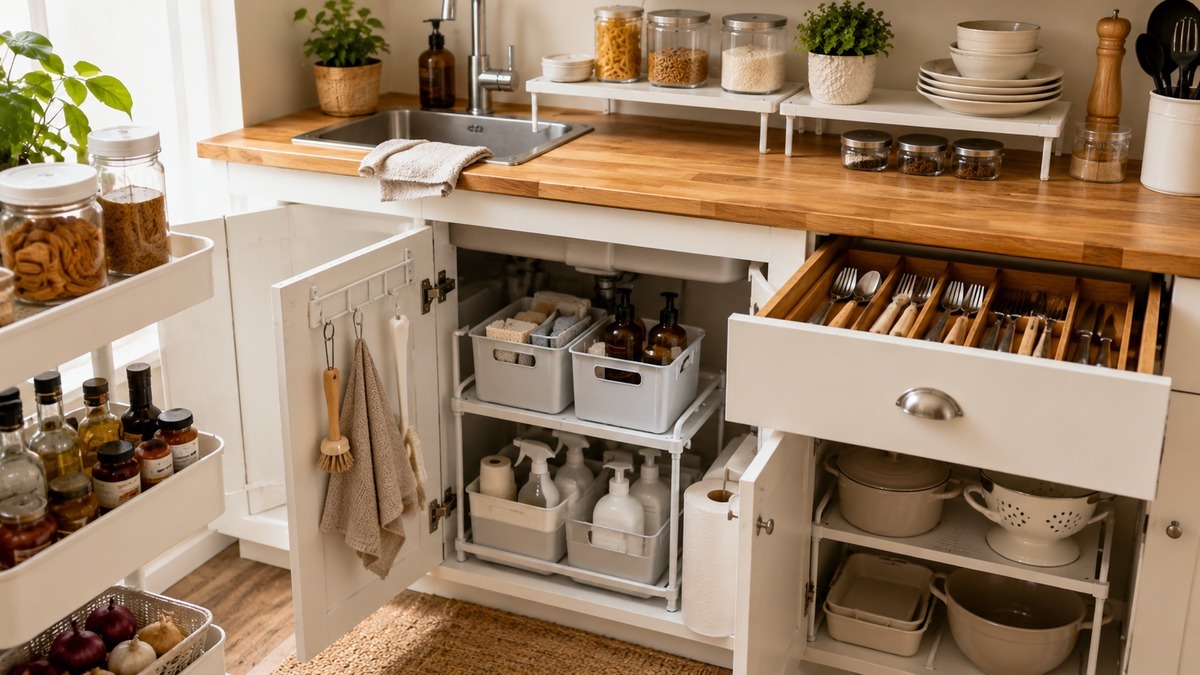
6. Make Kitchen Drawers Work Harder With Dividers
Small apartment kitchens often have too few drawers. When you only have one or two drawers for utensils, cooking tools, measuring spoons, bag clips, tea, matches, and random household items, the drawer becomes chaotic. A drawer organizer is not exciting, but it can make a huge difference in daily use.
Start by removing everything from the drawer. Group items by how often you use them. Daily utensils should be easiest to reach. Small tools such as peelers, measuring spoons, can openers, and thermometers should have a defined place. Rarely used gadgets can move to a bin, a higher shelf, or another cabinet.
Expandable bamboo or plastic drawer organizers are useful because rental drawers are not standard. If your drawer is very narrow, look for slim organizers or individual trays instead of one large insert. For deep drawers, use small bins to keep tools upright or separated. For shallow drawers, avoid bulky organizers that waste vertical space.
If you already have a messy utensil drawer, read our Best Kitchen Drawer Organizers for Small Apartments guide next. Kitchen drawers are often the easiest place to improve first because the change is immediate.
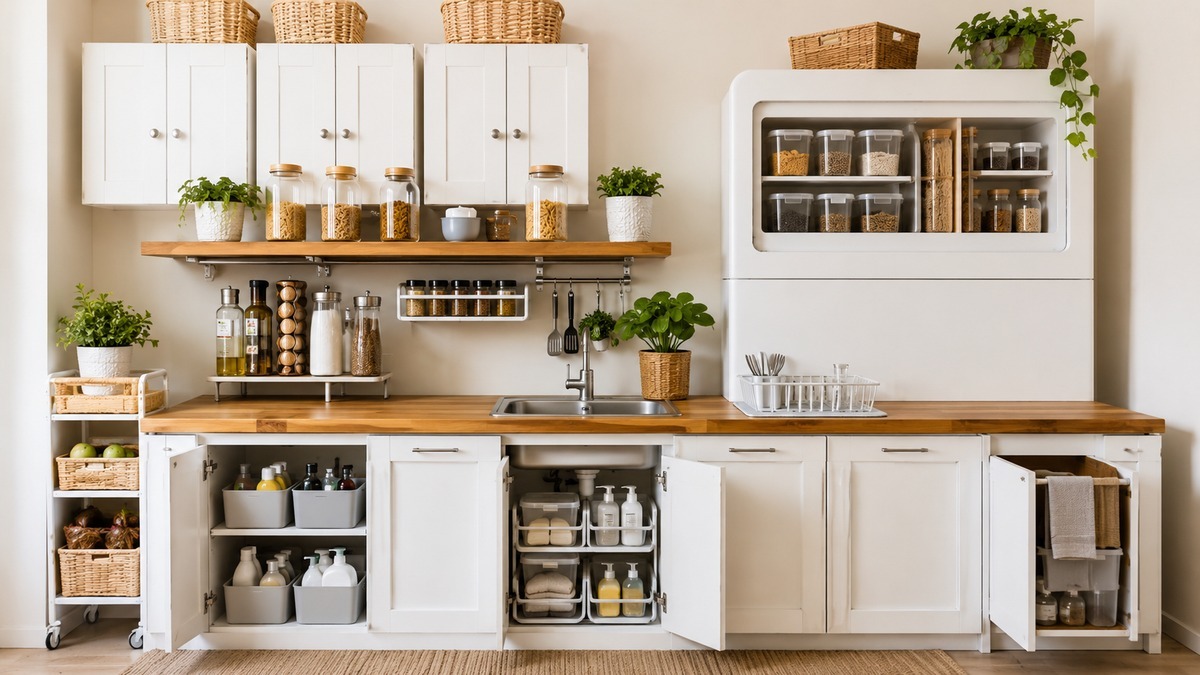
7. Organize Under the Sink Without Fighting the Plumbing
The under-sink cabinet is one of the hardest spaces in an apartment kitchen. Pipes, garbage disposals, shutoff valves, and awkward cabinet dimensions make it difficult to use. Many renters end up throwing cleaning sprays, trash bags, dish soap, sponges, and extra bags into one messy pile.
A renter-friendly under-sink setup should be flexible. Look for adjustable organizers that can work around plumbing, stackable bins that pull out easily, small caddies for cleaning supplies, and over-door baskets for lightweight items. Avoid rigid organizers that require a perfect rectangular space unless you have measured carefully.
It also helps to divide the cabinet by purpose. One bin can hold dishwashing items. Another can hold cleaning sprays. Trash bags can go in a small basket or over-door holder. Sponges and gloves can stay in a small caddy. If you keep everything loose, you will eventually have to dig through the cabinet again.
Before adding organizers, check for leaks or moisture. Do not place cardboard boxes or fabric bins under a sink where leaks could damage them. Plastic bins, metal racks, and washable caddies usually make more sense. For more ideas, see our Best Under Sink Organizers for Apartments and Under Sink Storage Ideas for Small Apartments.
8. Use Stackable Pantry Bins When You Do Not Have a Pantry
Many apartments do not have a real pantry. Instead, renters use one kitchen cabinet, part of a bookshelf, a cart, or a few shelves for food storage. Stackable pantry bins can help, but only when they make food easier to see and reach.
Use bins for categories: breakfast items, snacks, baking supplies, pasta and grains, packets, lunch items, or coffee and tea. Clear bins are helpful because you can see what is inside. Open-front bins can be easier than lidded bins for items you use every day. Lidded bins are better for less-used items or overflow storage.
Be careful with stacking. If you have to remove three bins to reach one item, you may stop using the system. In a small kitchen, convenience matters. Keep daily food at eye level or within easy reach. Put backup items higher or lower.
If your pantry cabinet is deep, use long bins that pull forward like drawers. If it is narrow, use smaller bins by category. If it is tall, combine bins with shelf risers. The goal is not to make your pantry look like a social media photo. The goal is to know what food you have and make cooking easier.
9. Add Damage-Free Hooks Carefully
Adhesive hooks can be useful in rental kitchens, but they should be used thoughtfully. They are best for lightweight items such as measuring cups, potholders, dish towels, reusable bags, small brushes, or lightweight utensils. They are not ideal for heavy pans, glass jars, or anything that could break if the hook fails.
The safest places for adhesive hooks are usually smooth, clean, sealed surfaces. Tile, metal, glass, and some laminate surfaces may work better than textured painted walls. Always follow the product instructions and weight limits. Clean the surface first, allow the adhesive to bond properly, and remove it slowly according to the directions when you move out.
Do not place adhesive hooks above a stove, in steamy areas, or on peeling paint. Heat, moisture, and poor surfaces can weaken adhesive. Also avoid installing too many hooks in one visible area. A wall covered with random hanging tools can make a small kitchen feel busier.
For general damage-free storage, our Best Command Hooks for Renters and No Damage Wall Storage Ideas for Renters guides can help you think through safer options.
10. Use Countertop Storage Only for Daily Items
Countertop storage is tempting because it is visible and easy to access. But in a small apartment kitchen, counter space is precious. Every organizer you place on the counter should earn its space. If it does not help you cook, make coffee, wash dishes, or prepare food more easily, it may belong somewhere else.
A small counter tray can work well for oils, salt, pepper, and daily cooking items. A compact dish rack can help if you do not have a dishwasher. A utensil crock may make sense if your drawers are too limited. A small coffee station can be useful if you make coffee every day.
But avoid filling counters with decorative jars, large baskets, rarely used appliances, and oversized organizers. A small kitchen feels calmer when the counter has open prep space. If you cannot chop vegetables, make a sandwich, or set down groceries, your storage system is taking too much from your daily routine.
For more focused counter ideas, see Small Apartment Kitchen Counter Organization Ideas. The best countertop setup is usually simple: keep only what you use often, group it neatly, and leave room to actually cook.
How to Choose the Right Renter-Friendly Kitchen Storage
Instead of buying based on what looks good online, choose based on your kitchen’s weakest point. A renter with no pantry needs different storage from a renter with deep cabinets and no drawers. A renter who cooks every day needs a different setup from someone who mostly reheats meals. Your storage should support your real habits.
Renter Problem vs. Best Storage Direction
| Kitchen Problem | Best Renter-Friendly Idea | Why It Helps |
|---|---|---|
| No pantry | Slim rolling cart or stackable pantry bins | Creates movable food storage without remodeling |
| Tall cabinets with wasted space | Shelf risers or under-shelf baskets | Adds layers without drilling |
| Messy utensil drawer | Expandable drawer organizer | Separates daily tools so you can find them quickly |
| Crowded counter | Cabinet door organizer or magnetic rack | Moves small items off prep surfaces |
| Under-sink clutter | Adjustable under-sink organizer and cleaning caddy | Works around pipes and keeps supplies grouped |
What I Would Buy First in a Small Rental Kitchen
If I were setting up a small apartment kitchen from scratch, I would not start with trendy organizers. I would start with the items that solve the most common daily frustrations without locking me into one apartment layout.
First, I would buy a simple drawer organizer if the utensil drawer was messy. It is low-risk, inexpensive, and immediately useful. Second, I would add shelf risers inside one cabinet if plates, bowls, cans, or pantry items were stacked too high. Third, I would organize under the sink with a washable bin or adjustable organizer, because cleaning supplies tend to become chaotic quickly. Fourth, if there were a narrow gap, I would consider a slim rolling cart for pantry overflow. Fifth, if the fridge side were magnetic and visible, I would use a magnetic spice rack or small magnetic basket.
I would wait on adhesive shelves, heavy wall-mounted pieces, and large freestanding units until I knew the kitchen better. I would also avoid buying a complete matching set of containers immediately. Matching containers can look beautiful, but if you do not know your cabinet dimensions or food habits yet, they can become expensive clutter.
Common Mistakes Renters Make With Kitchen Storage
The first mistake is buying too many organizers at once. When you do this, you are guessing instead of solving. Start with one cabinet, one drawer, or one counter problem. Live with that change for a few days, then decide what else you need.
The second mistake is ignoring measurements. Apartment kitchens are not standard. Cabinet depth, shelf height, drawer width, under-sink plumbing, fridge gaps, and counter clearance can all vary. A product that looks perfect online may not fit your kitchen. Measure first, especially for carts, under-sink organizers, shelf risers, and over-door organizers.
The third mistake is trusting adhesive products too much. Adhesive hooks and caddies can be very helpful, but they are not magic. Surface type, weight, moisture, heat, and removal method all matter. Use them for light items and avoid risky surfaces.
The fourth mistake is using storage to avoid decluttering. If you own twelve mugs but use two, a shelf riser may help, but it may also hide the real problem. Small apartment storage works best when you keep what supports your life now, not every item you might possibly use someday.
The fifth mistake is blocking movement. A cart, rack, or standing shelf that makes the kitchen harder to move through is not worth it. In a rental kitchen, comfort and flow matter just as much as storage capacity.
Amazon Search Ideas for Renter-Friendly Kitchen Storage
Use these searches when you are ready to compare current options. Product prices, availability, dimensions, materials, and reviews can change, so always check the current product page before buying.
Kitchen Storage Search Ideas
Useful Amazon Searches for Small Rental Kitchens
These searches are meant to help you compare renter-friendly categories, not pressure you to buy everything. Start with the area that causes the most frustration.
Cabinet Doors
Over-Cabinet Door Organizer
Useful for cutting boards, wraps, towels, and light under-sink items without drilling into cabinet doors.
Cabinet Shelves
Expandable Shelf Risers
A good choice when tall cabinet shelves waste space and plates, bowls, or pantry items are stacked too high.
Fridge Side
Magnetic Spice Rack
Great for renters with a magnetic fridge side and limited cabinet space for spices or small cooking items.
Narrow Gaps
Slim Rolling Cart
Helpful for renters without a pantry, as long as the cart does not block the kitchen walkway.
Under Sink
Adjustable Under-Sink Organizer
Useful when pipes make the cabinet awkward and cleaning supplies need a better system.
Drawers
Expandable Drawer Organizer
A practical first upgrade if utensils, measuring spoons, and cooking tools are mixed together.
Tip: Measure your cabinet, drawer, fridge side, or floor gap before ordering. Small kitchens vary a lot, and a good product still needs to fit your exact space.
What to Skip in a Rental Kitchen
Some kitchen storage ideas are useful in owned homes but risky or impractical for renters. You may want to skip wall-mounted pot racks that require screws, permanent shelves, cabinet modifications, heavy adhesive shelves on painted walls, oversized islands, and anything that blocks doors, drawers, appliances, or walkways.
You should also be careful with peel-and-stick products near heat, steam, or greasy surfaces. Even if they are removable, kitchen surfaces can be tricky. Grease, moisture, and heat can weaken adhesives or make removal messier. If you use adhesive organizers, choose small lightweight applications and follow removal directions closely.
Another thing to skip is buying storage before decluttering. If your cabinet is full of expired food, duplicate mugs, mismatched lids, and gadgets you never use, organizers will only make the clutter look more controlled. Take everything out, remove what does not belong, then buy storage for what remains.
How to Build a Better Kitchen Storage System Over One Weekend
If your kitchen feels overwhelming, do not try to fix everything in one shopping order. A simple weekend reset works better. On Friday night, choose one cabinet, one drawer, and one counter zone that bother you most. Remove everything from those areas and group items by use.
On Saturday, declutter duplicates and items you do not use. Check expiration dates in pantry items. Match food containers with lids. Move rarely used items to higher shelves or less convenient spaces. Keep daily items close to where you use them. Measure the spaces that still need help.
On Sunday, choose only one or two storage products to buy or order. Maybe you need a shelf riser and drawer organizer. Maybe you need an under-sink bin and over-cabinet basket. Maybe a rolling cart makes sense because you truly have no pantry. By limiting your first purchase, you avoid buying items that only create more clutter.
This slower approach may feel less exciting, but it usually creates a kitchen you actually maintain. The goal is not a perfect before-and-after photo. The goal is a kitchen where you can make breakfast, pack lunch, wash dishes, and cook dinner without fighting your space every day.
Free Printable
Download the Free Small Apartment Move-In Checklist
Use our printable checklist to plan first-night essentials, kitchen basics, bathroom basics, cleaning supplies, storage, and what to buy later.
Related Guides
- Small Kitchen Storage Ideas for Apartments
- Best Kitchen Organizers for Small Apartments
- Small Apartment Kitchen Cabinet Organization Ideas
- Small Apartment Kitchen Counter Organization Ideas
- Best Kitchen Drawer Organizers for Small Apartments
- Best Spice Racks for Small Apartment Kitchens
- Under Sink Storage Ideas for Small Apartments
- Best Under Sink Organizers for Apartments
- No Drill Storage Ideas for Renters
- Best Renter Friendly Organizers for Apartments
FAQ
What is the best renter-friendly kitchen storage idea?
The best renter-friendly kitchen storage idea depends on your biggest problem. For most renters, shelf risers, drawer organizers, over-cabinet door organizers, under-sink bins, and magnetic fridge racks are good first options because they do not require drilling and can be removed later.
Can renters use adhesive kitchen organizers?
Yes, but use them carefully. Adhesive organizers work best on smooth, clean, sealed surfaces and should be used for lightweight items. Avoid heavy loads, textured paint, peeling surfaces, high-heat areas, and steamy spots. Always follow the installation and removal instructions.
How do I add kitchen storage without drilling?
Use organizers that sit, slide, hang, roll, or magnetically attach instead of drilling. Good options include shelf risers, under-shelf baskets, over-cabinet door organizers, slim rolling carts, magnetic spice racks, drawer dividers, stackable bins, and adjustable under-sink organizers.
What should I organize first in a small apartment kitchen?
Start with the area that affects your daily routine most. For many renters, that means the utensil drawer, the cabinet with plates and bowls, the under-sink cleaning area, the pantry cabinet, or the counter space used for food prep.
Are rolling carts good for apartment kitchens?
Rolling carts can be very useful if you have a narrow gap or no pantry. They are renter-friendly because they are movable and removable. However, they are not a good choice if they block your walkway, interfere with appliance doors, or become a catchall for random clutter.
How do I keep my rental kitchen organized long term?
Keep daily items easy to reach, avoid buying too many organizers at once, measure before purchasing, declutter duplicates, and give each storage area a clear job. A small kitchen stays organized when the system matches your real habits.
Final Thoughts
A renter-friendly kitchen does not need permanent shelves, expensive remodeling, or a perfect layout. It needs practical storage that respects your lease and supports your daily life. Start with the cabinet, drawer, counter, or under-sink area that frustrates you most. Choose removable organizers that fit your actual space. Avoid heavy, permanent, or oversized solutions until you are sure they make sense.
The best small apartment kitchen storage is not the most complicated system. It is the system that makes cooking, cleaning, and putting things away feel easier. If you build it one problem area at a time, your kitchen can become calmer, more useful, and much less stressful without risking your security deposit.
Next, you may want to read Small Kitchen Storage Ideas for Apartments, Best Kitchen Organizers for Small Apartments, or No Drill Storage Ideas for Renters.